

The racing season in India is getting underway, and the past few weeks have already given us a glimpse of some impressive running achievements – by some incredibly dedicated runners, and a few who perhaps weren’t quite as dedicated as they would have us believe.
It has also shown how differently people interpret the idea of showing up and what dedication really means.
The recent Ladakh Marathon is a good example.
I had an athlete running the tough Silk Route Ultra. She went into the race with relatively little training, less than 85 km per week, with her longest run no longer than 32 km. Yet she performed extremely well, narrowly missing her sub-20-hour target, finishing 5th and coming home with a substantial amount of prize money.
As I followed the training and results of many other runners, it was no surprise to see some of the chronic over-trainers struggling simply to get to the finish line.
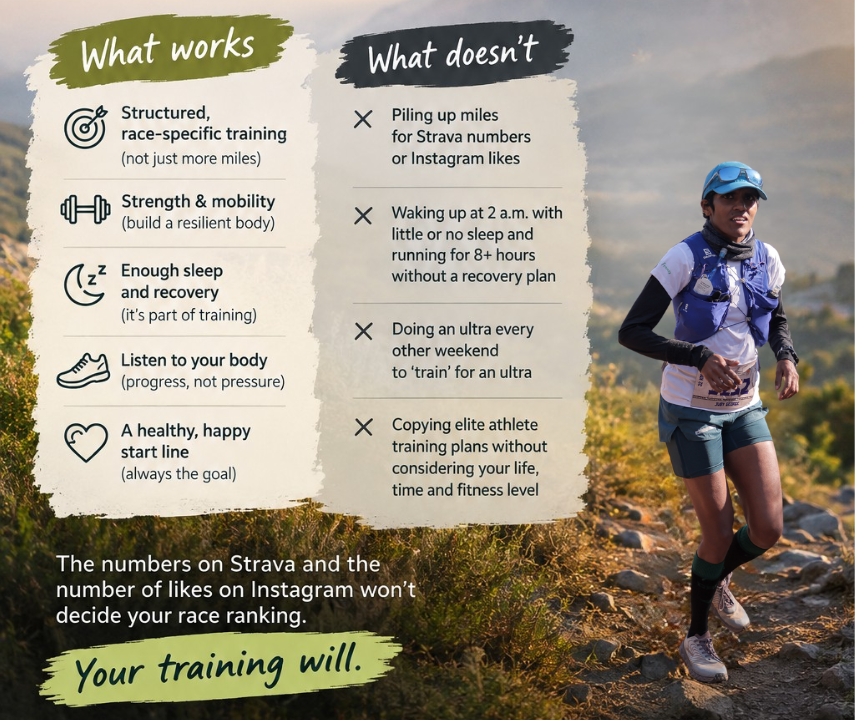
Some had elaborate social media posts about how they “show up” after piling on junk mile after junk mile, often without structure, recovery, or any real race-specific training. Waking up at 2 a.m. after little or no sleep and then running for eight hours without a proper recovery strategy is not “showing up”.
That’s poor training.
Training is not just about running. Rest and recovery are part of training too.
Doing an ultra every other weekend to prepare for an ultra? I see this every season. More often than not, these runners end up injured and spend the rest of the season trying to recover.
And amateur runners with full-time jobs, family commitments and limited training time trying to replicate the training volume of an elite athlete? That simply doesn’t make sense.
Smart training is structured and race-specific.
It includes the right balance of running, strength, mobility, rest and recovery and, importantly, enough sleep.
Piling up kilometres for Strava numbers or Instagram likes might look impressive online, but it doesn’t necessarily translate into race performance.
Your training will.
As a coach, I’d much rather have an athlete reach the start line 10% undertrained, but healthy, happy and ready to race, than 10% overtrained, exhausted and carrying a collection of aches and pains.
So, train smart.
Focus on quality, not just quantity.
Show up for the training but also show up for the recovery.


Leave a Reply